
... and the shackles of sin fall. By Kai Mester
Reading time: 7 minutes
Out of love for Abraham, God gave his Hebrew people the Torah, the prophets and Jesus. This brought light and peace to many. The apostles carried these gifts into the whole world - especially in Greek: a blessing!
Unfortunately, Greek thinking soon made its way more and more into Christianity: a curse! It would be best if we thought less Greek. Then we will understand and appreciate God's gifts better.
The previous Pope Joseph Ratzinger, alias Benedict XVI, warned against this de-Hellenization of Christianity. Because hardly any other Christian church has surrendered to Greek thinking as much as the Roman Catholic Church.
But the rest of Christendom has also been strongly influenced by Greek thought, even Judaism and Islam have not been able to resist it. For example, the belief in the immortal soul gained a foothold everywhere through Platonic philosophy.
Hostility towards the body
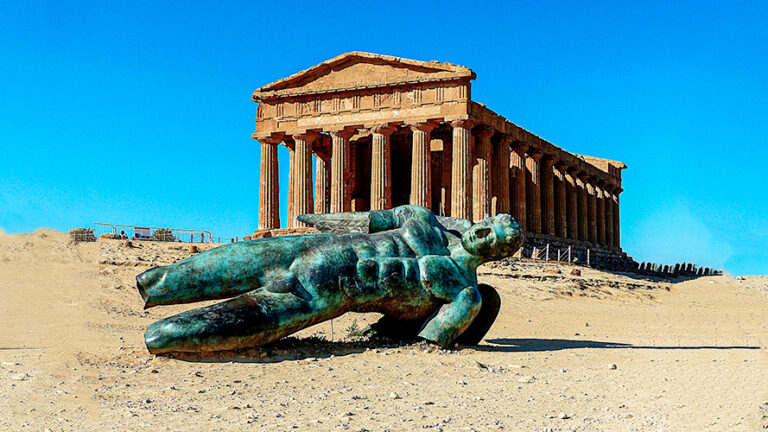
If the soul leaves the body anyway, then death must be a liberation and the body a prison. This devaluation of the body has consequences. It is then enslaved at the expense of spiritual goals. The Spartans enslaved it in order to win the war. At the Olympics, the body is enslaved in order to win medals. The cult of nudity in statues and the Olympic Games also only seemingly idolizes the body. Freed from all coverings, it is morally unprotected. In the end, the Greeks were even known for the fact that men had their love boys. But if the soul leaves the body anyway, you can also live a dissolute life. The body can then take no real revenge if you gratefully shake it off at some point anyway.
Fight and competition
The Olympics stands for competitive sport. Only one person can be the winner in each sport. This means fighting against everyone or as a team against all other teams. It is no different in war, and competitions also work according to this principle. Jesus came to break with this spirit. But Hellenism managed to hijack Christianity for its own purposes.
Headedness and segmentation
The mind is so far above the body that one can lose touch with reality through abstraction. Rational acrobatics lead to strange theories and doctrines. The pictorial thinking and acting of Hebrew, which is perceived and experienced with all the senses, fades more and more. Now it is purely about rational thinking: I think, therefore I am, instead of I am, therefore I think. Abstraction becomes more important than the thing itself. Holism is lost, the essentials are lost sight of. Reality is reinterpreted and distorted, even ideologized by philosophy and theology. Everything is divided into categories, decoupled, separated, segmented. Thought structures become dogmas, and dogmatism leads to the persecution of dissenters who do not fit into the official mold.
The parables of Jesus or Proverbs of Solomon are quite different, the open discourse towards the main sum of all teachings: the fear of God.
Back to biblical-Hebrew thinking
Greek thinking has imperceptibly alienated us from the Gospel. Therefore, a healthy de-Hellenization is an important step towards a true knowledge of God. So back to biblical-Hebraic thinking and to reading the Greek New Testament with the Hebraic approach of the Old Testament. For these were the language structures and mentality of all twelve apostles, including the apostle Paul.
Back to the true anointed one
Even the central figure of the entire Bible, Jesus of Nazareth, has been Hellenized by the term Christ (Christos). The Hebrew term from which the word was borrowed is Messiah (Maschiach) and means anointed one. When we read or hear the word Christ, we do not ask ourselves: anointed with what, by whom, why and for what purpose, where and how? Rather, other associations resonate: Christianity, being Christian, Christendom, Christianity, crucifixes, crusades, church, divinity, etc. So, by and large, references from the Greek-Christian world. Messiah would bring more links to the Jewish context.
The alienation of Christianity from Hebrew culture created a vacuum into which new concepts fitted, for example Greek Gnosticism. To this day, classical Christian theological education colors Christianity through its focus on the Greek language. For example, there is talk of agape love and a God who stands outside of space and time, as well as other Greek concepts. Salvation is understood in a legal-abstract way and no longer holistically. Thus, most Christians live in a few major or numerous minor sins, and the world finds their testimony neither convincing nor attractive. Christian divorce rates are alarmingly high, and serious illnesses are ravaging young Christians.
But even the epicenter of Jewish culture, the modern state of Israel, where Hebrew is the everyday language, suffers from the same Greek, or shall we say, human symptoms: abstract thinking, competitive spirit, mindlessness and segmentation, and hostility to the body through militarism and body worship.
The only cure is in Jesus the Anointed One. He has shown us the true nature of his and our God, which renders human wisdom speechless. From the Sermon on the Mount to Golgotha, he shows us a God who does not fit into Greek thinking. That is why this God remained the unknown God in Greece for a long time. Turning the other cheek, carrying his cross, allowing himself to be crucified, giving attention and affection to the weak, not resisting evil but repaying evil with good, neither judging nor condemning, loving the enemy, clothing the naked. Sorry, Sparta, Athens, Corinth and Olympia, this is a world that has the potential to dissolve yours into stardust.
One day there will be many Greeks in the kingdom of heaven who lived entirely in their mentality before their conversion. So there is hope for everyone. For you and me too!
See also:
https://en.m.wikipedia.org/wiki/Dehellenization_of_Christianity
Source: hoffnung-weltweit.info
Recommended: