

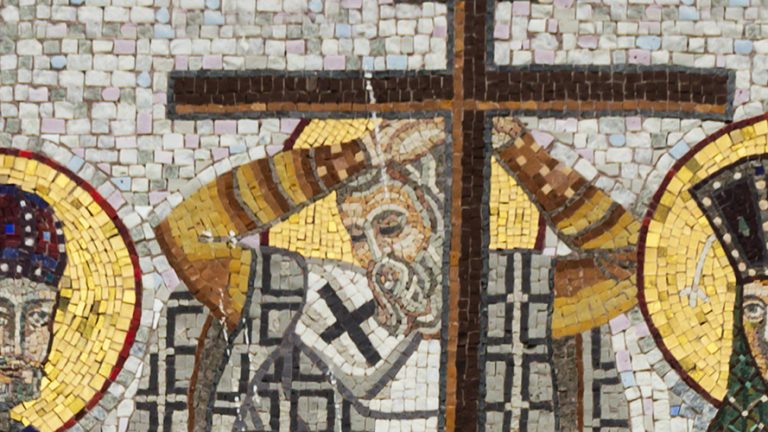
What the cross has in common with Sunday. By George Burnside
The author was a well-known Seventh-day Adventist preacher and evangelist in Australia. He died in 1994. The following article was apparently written when it was generally considered offensive for an Adventist to wear or hang crosses. Here are the reasons given at the time. They are worth reconsidering.
"Why don't we have crosses on our churches?" someone asked me. "Why are there no crosses in our places of worship?" We would do well to consider a few facts.
1. the biblical testimony
These questions are best answered with the "law and testimony" (Isaiah 8:20). When we search the Bible, we find that neither the Old Testament nor the New Testament tells us of an instance where a three-dimensional cross was placed in or associated with the place of worship.
2 The time of introduction
Furthermore, we discover that there is no indication in the Bible or in history that the cross was used as a Christian symbol in the first three centuries of the Christian era. Even the Roman Church confirms this:
"It is safe to assume that Constantine did not use the cross as an enduring sign of our salvation until after the Edict of Milan (312 AD). De Rossi, a Roman Catholic archaeologist, says explicitly that none of the Christ monograms discovered in the catacombs or elsewhere can be dated to before 312."(American Ecclesiastical Review, September 1920)
So there is general agreement that the cross as a Christian symbol has only existed since the time of Constantine.
According to the Catholic Encyclopaedia, volume 4, pages 298-299, Constantine had a monogram of the name of Christ affixed to the labarum, the standard of the Roman Empire. When Constantinople was consecrated in 330 AD, the celebrations were half Christian and half pagan. The war chariot of the sun god was placed in the market square and the so-called cross of Christ was placed above it while the Kyrie Eleison was sung (another remnant of paganism, according to Cardinal Newman).
"Constantine was the first emperor to enforce the great body of civil laws governing Sunday rest. He was the first to officially replace the Lord's Day with Sunday or the day of the sun ... There were two sides to Constantine's life - he was half Christian and half pagan. He was as popular with his pagan subjects as he was with his so-called Christian subjects ... [He enacted the first Sunday law and] under his reign the cross was for the first time made a recognized symbol of Christianity and abolished as a common means of execution." (Edmund Klut in: These Times, June 1956, p. 28)
Isn't it significant that Sunday and the cross were introduced at the same time in the so-called Christian church? The one is just as pagan as the other. Neibuhr aptly summarizes Constantine's motives for introducing the cross as a Christian emblem:
"His motives for founding the Christian religion are indeed somewhat peculiar. The religion he had in mind must have been a mere hodgepodge. His coins featured 'the unconquered sun'; he worshipped pagan deities, consulted soothsayers and remained faithful to pagan superstitions. Nevertheless, he closed the temples and built churches.
No, nothing justifies the claim that the cross is a Christian symbol. Before the year 300 AD, the Christian symbols were the fish, the anchor, the ship, the dove and the palm branch. The cross was only introduced as a Christian symbol when the empire of Rome identified itself politically with Christianity and thus became papal Rome!"
(Neibuhr, Bible and Modern Discoveries, pp. 104-105)
3 The pagan origin
"The cross is found in both pre-Christian and non-Christian cultures. The cross was a well-known pagan symbol. In the British museum you can see the statue of Samai Vul - the king of Assyria, 825 B.C. On his chest he wears this †. The robes of the priests of Horus - the Egyptian god of light - are adorned with this †. In the royal tombs in Thebes, the royal cows are depicted plowing, with a calf playing in the foreground. Each animal has the familiar † in various places. M. Rassam found buildings in Nineveh that were marked with the Maltese cross. Osiris and also Jupiter Ammon had a † as a monogram."(New Catholic Encyclopaedia, vol. 4, p. 473)
"The cross has been venerated in Egypt and Syria since early antiquity. The Buddhists of the East worshipped it in the same way." (W. D. Killen, 1859, p. 316)
"The cross had its origin in ancient Chaldea (Babylon), where it was used as a symbol of the god Tammuz, as the initial letter of his name." (W. E. Vine in: An Expository Dictionary of the New Testament Words, vol. 1, p. 256)
"The sign of the cross, represented in its simplest form - namely, by crossing two lines at right angles, was known in both East and West long before the introduction of Christianity. It goes back to a very remote period of human civilization."(Catholic Encyclopaedia, 1908, vol. 4, p. 517)
"An altar of the Philistines in the innermost sanctuary was the most valuable find: a paneled altar of basalt, with a cross carved in high relief on the top." (J. Carrow Duncan, Digging Up Biblical History, p. 109)
"The cross was the symbol of worship in Egypt and Syria in the transitional period between the High and Late Ages. Solemn religious acts similar to those of the Lord's Supper and baptism [meaning here the Catholic Mass and the sprinkling of children] were practiced by pagan peoples on whom the light of Christianity had never shone." (William Hickling Prescott, Conquests of Mexico, vol. 2, pp. 382-383)
4 The unchristian use in Christian times
"Was the cross also used by pagans in the Christian era?" is a question I was recently asked.
Without a doubt! In the New Hebrides, pagans still use it today. When the Spaniards invaded Mexico some 500 years ago, "they could not suppress their astonishment when they saw the cross - the sacred emblem of their own faith - as it was erected as an object of worship in the temples of Anahuac. They encountered it in various places. The image of a cross can still be seen today, sculpted in bas-relief, on the walls of a building in Palanque." (Ibid., p. 381)
"As the Jews pretended to honor the law, so the Roman Church claims to glorify the cross. The symbol of Christ's sufferings is exalted, while the one it represents is denied in practical life. The Pope's followers place crosses on their churches, altars and vestments. Everywhere one sees the sign of honor of the cross; everywhere it is outwardly venerated and exalted. But Christ's teachings are buried under a mass of senseless traditions, false interpretations, and strict precepts." (Ellen White, The Great Controversy, p. 568)
Jesus' true cross
Jesus said, "If any man will come after me, let him deny himself, and take up his cross, and follow me." (Matthew 16:24). He did not mean that you should wear a cross made of gold around your neck, or that you should hang it around your neck with a chain or cords. Nor should it be placed on the inside or outside of the church. When Paul said, "But far be it from me to boast except in the cross of our Lord Jesus Christ", he immediately added, "by which the world has been crucified to me, and I to the world". (Galatians 6:14). It is the crucified and risen Savior who saves and not a physical cross.
The question is asked: "Why don't we have crosses?" Why not the question: "Why don't we hang up crucifixes?" These at least have a clearer Christian appearance. Why not ask: "Why don't we cross ourselves?" That would be just as logical as the cross on a church building.
We don't need these remnants of paganism. Since the time when Emperor Constantine made the cross his emblem, all churches that were half Christian and half pagan have used this symbol. Protestant churches have often been guilty of the same. As Lot pitched his tent towards Sodom, so too many Protestant churches camp at the gates of Rome. May we all heed the call, "Come out of her, my people!" instead of asking whether we should not adopt some of her ways.
"The stamp of Christianity is not an outward sign, not the wearing of a cross or a crown - it is rather that which reveals man's union with God. Through the power of his grace, which becomes visible in the transformation of character, the world is to be convinced that God has sent his Son as Savior. No other influence that surrounds the human soul has as much power as the influence of a selfless life. The strongest argument for the Good News is a loving and lovable Christian." (Ellen White, Ministry of Healing, 470)
Abridged from: The Anchor, Kalbar QLD, Australia, September 1999
Source: hoffnung-weltweit.info