
PODCAST
Why did Jesus celebrate Hanukkah but not Christmas? By Kai Mester
On December 24, the “Christian” world celebrates its ‘Holy’ Evening. It commemorates the birth of Jesus in Bethlehem. No other holiday is celebrated as extensively by Christianity today as Christmas. Rarely does “so much money ring in the cash register” as during the Christmas season.
But why is there no mention in the New Testament of Jesus or the apostles celebrating his birthday? Why did Jesus and the apostles celebrate completely different festivals?
At the same time, Jews also celebrate a festival: Hanukkah, the festival of temple dedication, also known as the festival of lights. (Other spellings: Chanukkah, Hanukka, Hanukah) It is a rare occurrence in the calendar that this festival begins on the 24th. This last happened in 2016 and will happen again in 2027. In any case, it makes sense for Christians to reflect on this Jewish festival—because it is actually mentioned in the New Testament (see below).
When I take a closer look at the Jewish Festival of Lights, it is very different from Christmas. However, there are also similarities in some respects. The comparison makes me very thoughtful.
The biggest difference between the two festivals is their origin:
Origin of Christmas
Practically everyone knows that Christmas is not Jesus' actual birthday. The Bible is silent about Jesus' exact date of birth. All we know is: “There were shepherds ... in the fields, keeping watch over their flock by night” (Luke 2:8). However, this does not sound like the end of December, even in the Middle East.
Why did the apostles not inform us of Jesus' exact date of birth in their Gospels? Did they not know it themselves? In any case, Luke writes that Jesus was “about” 30 years old when he was baptized (Luke 3:23). Well, the Hebrew Bible only mentions one birthday: the birthday of Pharaoh (Genesis 40:20), on which the cupbearer was reinstated to his office, but the baker was hanged. The Apocrypha mentions the birthday of Antiochus IV Epiphanes, about whom we will say more in a moment. On his birthday, he forced the inhabitants of Jerusalem to participate in the festival of Dionysus, the god of wine (2 Maccabees 6:7). The New Testament also mentions a birthday, that of King Herod, on which John the Baptist was beheaded (Matthew 14:6). Three pagan kings who are not role models for us. However, we learn nothing about the birthdays or birthday celebrations of such important men of God as Moses, David, or Jesus.
Why then does Christianity celebrate December 25 as Jesus' birthday?
According to the Roman calendar, December 25 was the date of the winter solstice and was considered the birthday of the sun god “Sol Invictus.” From December 19 to 23, the days are the shortest. From the 24th onwards, they become longer again. To the ancient peoples with their sun cult, this seemed like a rebirth of the sun.
Historically, the first evidence of a “Christian” Christmas celebration dates back to 336 AD, one year before the death of Emperor Constantine the Great. In his view, the Christian God and the sun god Sol were one and the same. That is why, in 321 AD, he made the day of the sun a weekly day of celebration and rest. Emperor Constantine is known for merging Christianity with sun worship and making it the state religion. And this legacy is still visible in many ways in Christianity today.
How different is the story of the Jewish festival of lights:
Origin of Hanukkah
The Jewish festival of Hanukkah was proclaimed by Judas Maccabeus as an eight-day festival of temple dedication and lights after the temple was liberated from the hands of the tyrant Antiochus IV Epiphanes on December 14, 164 BC, cleansed of idolatry, and rededicated to God.
Antiochus Epiphanes had erected an altar to Zeus in the Temple in Jerusalem, banned Jewish rites and traditions, and essentially reintroduced the cult of Baal under a different name. Both the Phoenician god Baal and the Greek god Zeus were worshipped as sun gods, as was the Persian and Roman god Mithras. Antiochus had pigs sacrificed on the altar and sprinkled their blood in the Holy of Holies. Sabbath observance and Jewish festivals were forbidden, and circumcision and possession of the Hebrew Bible were punishable by death. All biblical scrolls that could be found were burned. In this way, he became a precursor to the medieval persecutors. It was not without reason that the Jesuit Luis de Alcázar, in the course of the Counter-Reformation, identified the horn from Daniel's prophecy with Antiochus in order to use his school of preterism to refute the Protestant interpretation, which saw the papacy in it. Many features of the prophecy did indeed apply to him, but not all of them.
Hanukkah is also based on an important event in the history of Israel. Unlike Christmas, this festival was not invented centuries after the event it is supposed to celebrate. It is not a festival that was intended to give a millennia-old religious celebration the appearance of a completely different religion and even make it its most important festival. Hanukkah is deeply rooted in Jewish consciousness. Anyone who delves into the origins of this festival does not have to recoil in horror, because its origins were a symptom of one of the most unholy marriages in history: the marriage of state and church, of sun worship and Christianity.
But why is Hanukkah not celebrated on December 14 every year?
Hanukkah dates
This year, Hanukkah will be celebrated from the evening of December 14 until nightfall on December 22. However, the Jewish calendar does not correspond to the papal Gregorian calendar. It is not a solar calendar, but a lunar calendar in which the months begin with the new moon. In order to celebrate the three harvest festivals of Passover (barley harvest), Shavuot (Pentecost, wheat harvest), and Sukkot (Feast of Tabernacles, grape harvest) on fixed dates, an additional month had to be inserted every two or three years. As a result, the festival takes place at a different time each year. December 5–12, 2026; December 25–31, 2027; December 13–20, 2028; December 2–9, 2029; November 21–28, 2030, etc. This makes it clear that Hanukkah is not based on the birthday of the sun god, even though it is close to the winter solstice.
This is another significant difference from Christmas.
Let's now take a look at the customs.
Hanukkah candle custom
How exactly have Jews been celebrating this festival for over 2000 years? The Talmud explains that when Judas Maccabeus recaptured the Temple, a great miracle occurred: in order to light the seven-branched candelabrum, the menorah, the purest olive oil was needed, which was released by the High Priest. However, only one bottle of it could be found. This would only last for one day. But miraculously, it lasted for eight days, exactly the time needed to produce new kosher oil.
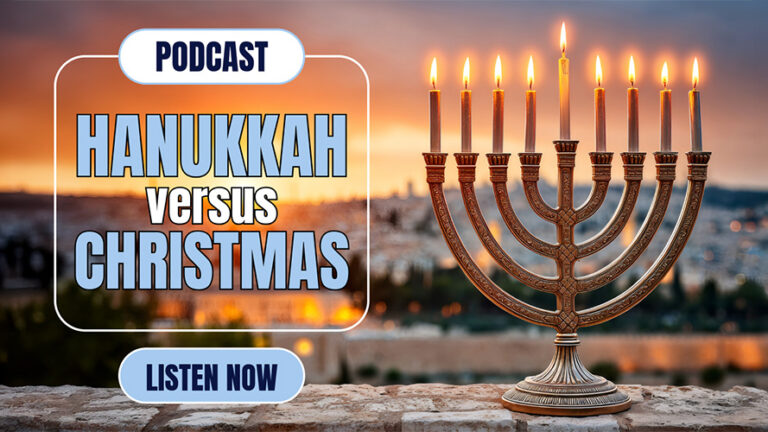
Therefore, this year, on the evening of December 14, after dark, Jews light the first candle of the Hanukkah menorah. It must burn for at least half an hour. The next evening, the second candle is lit, and so on until the eighth and last day. The candles are lit with a ninth candle called the shamash (servant). Therefore, this menorah, also called a Hanukkiah, does not have seven arms like the menorah, but nine.
At first glance, we see a similarity here: lights are lit during Advent and Christmas. Some say they think of the miracle of the Incarnation (Jesus, the light of the world), while others think of the miracle of the seven-branched candlestick, which symbolizes both the Messiah and the individual believers and his congregation.
In Christianity, however, lamps and candles did not become commonplace in worship until the end of the 4th century. This is because early Christians considered their ritual use too pagan. The Germanic Yule festival at the winter solstice, which influenced the European Christmas celebration, also had lighting customs.
The festivals also differ a little, like an artificial flower and a natural flower. From a distance, both look similar. But the closer you get, the uglier the artificial flower becomes. Its entire essence is specifically adapted to the effect it is supposed to achieve. But at its core, it has nothing to do with a flower and its divine message of love.
But with natural flowers and biblical festivals, you can even use a microscope and marvel at their beauty over and over again. The Hanukkah menorah is closely linked to the biblical menorah and has always emphasized deep biblical truths, which are expressed in the three blessings recited when lighting the candles:
1. “Blessed are You, Lord our God, King of the universe, who has sanctified us with His commandments and commanded us to kindle the light of consecration.” Which Christian still allows Himself to be sanctified by God's commandments today? Very few. Where are we going when we light candles everywhere? And not just any light, but the light that makes our temple (us as God's children and God's congregation) shine in divine holiness?
2. “Blessed are You, Lord our God, King of the universe, who performed miracles for our ancestors in those days, at this time.” This blessing reminds us that we should never forget how God has guided us individually and as a people in the past. His history with His people, from creation through the Flood, the Exodus, the Babylonian exile, the Maccabean period, and the coming of the Messiah, through the Reformation and Advent history to the present day, is a continuum that cannot be destroyed despite all the ups and downs. Christmas, however, stands for those who “have crept in” (Jude 4), for the one “who has seated himself in the temple of God as God, proclaiming himself to be God” (2 Thessalonians 2:4, paraphrase). A festival that at its core represents a completely different orientation and philosophy has cloaked itself in Christian garb. In it, Jesus is worshipped in the phase of his earthly life where he was least able to radiate or explain God's character and least able to fulfill his mission, when compared to the three years of his ministry, his suffering, and his work after his resurrection until today. For at first, as an infant, he was no different from most human children: poor, helpless, a human being like you and me.
3. “Blessed are You, LORD our God, King of the universe, who has given us life, sustained us, and brought us to this season.” God has a plan for us. He wants to use us as lights today! Hanukkah raises the question of the Temple. Where is it today? Where does the miracle of light happen today? Most Jews cannot give a positive answer to this question. But if you know Jesus, Hanukkah makes you think.
Other Hanukkah customs
On Hanukkah evenings, joyful celebrations are held among family and friends. During the day, people go about their normal work. In the evening, however, there are sweet fried pastries, doughnuts, and potato pancakes. Special Hanukkah songs are sung, and people gather in the synagogue or outdoors to light the candles. Prayers are said, the Hanukkah story is told, and games are played. People are also particularly generous and charitable during this time. Gifts are exchanged. Psalms 30, 67, and 91 are especially popular recitations during Hanukkah.
The apparent similarities between Christmas and Hanukkah stem from the fact that both are festivals. Their character as festivals of light is particularly evident in our northern latitudes during the dark winter months. Nehemiah already recommended sweet drinks and rich foods for festive days (Nehemiah 8:10). It is immediately clear to anyone who is health-conscious that these do not have to be fried or roasted, refined or sugared foods, and this allows them to be creative.
In any case, it must mean something that Jesus never asked us to celebrate his birthday, yet he expressly asked us to celebrate another feast: the Lord's Supper, where we are to commemorate his sacrificial death...
And what is his position on the feast of Hanukkah?
Jesus and Hanukkah
The Gospel of John records the speech he gave at Hanukkah: “Now the Feast of Dedication was taking place in Jerusalem; it was winter.” (John 10:22) This statement appears in the middle of the discourse on the Good Shepherd. With it, he concludes the teaching he has been giving since his arrival in Jerusalem for the Feast of Tabernacles in the autumn of 30 AD. Thus, only a few months before his death, Jesus took part in the celebrations of the Feast of Tabernacles and Hanukkah.
The message he proclaimed during this stay in Jerusalem is interesting:
At the Feast of Tabernacles: “I am the light of the world. Whoever follows me will never walk in darkness, but will have the light of life.” (John 8:12) For there was also a custom of lighting lamps at the Feast of Tabernacles, when two tall lamps were lit in the courtyard at the time of the evening sacrifice to illuminate all of Jerusalem and thus commemorate the pillar of fire that had led Israel out of Egypt.
Just two months later, at the Feast of Hanukkah, he said: “I am the good shepherd ... My sheep hear my voice, and I know them, and they follow me; and I give them eternal life.” (John 10:11, 27-28) With these two speeches, Jesus revealed the secret of the Sermon on the Mount: “You are the light of the world.” (Matthew 5:14) For now it was explained how this could happen. We can only become light for the world if we recognize God's light in Jesus and follow him into the heavenly sanctuary, yes, into the heavenly Holy of Holies, hear his voice, and receive his life.
In this way, Jesus revealed the deep meaning of the festival of lights and dedication, Hanukkah. Although it had its origins in the intertestamental period of Israel, when the prophetic voice was silent, this festival keeps alive the memory that God did not abandon his people and his temple even in this dark time, but performed a miracle to preserve the temple service until the first coming of his Messiah. The seven-branched candlestick burned again, the temple was rededicated. Thus, the festival of Hanukkah foreshadowed Jesus' arrival as the true light of the world nearly 200 years later, as well as the cleansing of the earthly sanctuary, which he performed at the beginning and end of his ministry on earth, and the cleansing of the heavenly sanctuary, which would precede his return.
Hanukkah therefore even has an eschatological message: the victory of the Maccabees over Antiochus was a picture of the victory of the Reformation over the Inquisition and of the calls of the three angels, who soon afterwards and even today call on all inhabitants of the earth to follow Christ without compromise.
Light and darkness
During Hanukkah, lights are lit. This is in keeping with the biblical command: “I will keep you and make you a covenant for the people, a light for the nations, to open the eyes of the blind, to bring out the prisoners from the dungeon and those who sit in darkness from the prison... so that you may be my salvation to the ends of the earth!” (Isaiah 42:6-7; 49:6) “Then your light will break forth like the dawn.” (Isaiah 58:8) “Arise, shine, for your light has come, and the glory of the Lord rises upon you!” (Isaiah 60:1)
This bringing of light cannot be limited to candles. People need light in the darkness so that they do not stumble and stray from the path. How sad it is when people only light artificial lights but remain in darkness inside!
Hanukkah appeals to me! Why don't we explore the neglected festival of Hanukkah? Hanukkah menorahs are easy to order online. Biblical topics of conversation for the evenings are easy to find. Why not make this festival a permanent part of our annual calendar? It has much to tell us about our God and our Lord Jesus.
Recommended: